Logos
Artists with Musicbrainz IDs, that qplanner is aware of, can have logos assigned to them.
These logos are then available to any planner with that artist.
Once an artist has a logo, all you need to do is toggle it on a performance.
Logos should reserved for headlining artists.
If you want to be a bit loose with that and uses logos for each stage headliner, or whatever, then that's ok.
The logo window
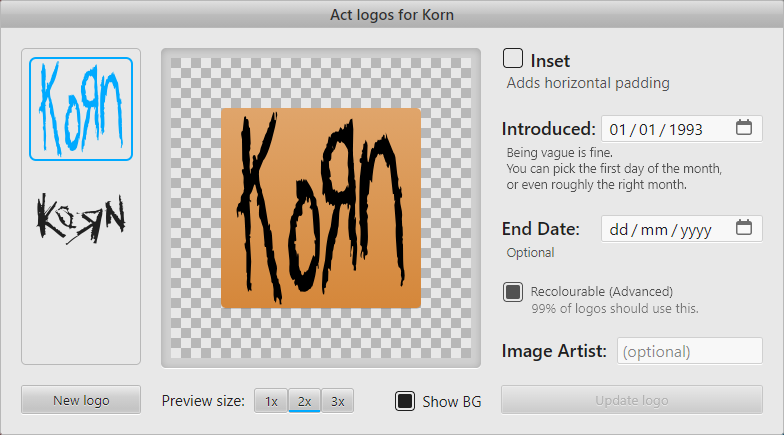
The logos window has 3 columns.
On the left you'll see any existing logos, which you can click to load, should they need modifying.
In the middle is a preview area.
You can change the scale to give yourself a better view of the details, or how it'll look in a planner.
Enabling Show BG contains the logo like it's a performance. The background colour is random, a suitably contrasting colour will be used to recolour the logo.
Move the cursor off of the Show BG, and then hover it over it, to see the colours automatically change every second.
The column on the right contains the details for the logo.
The image
In the middle of the preview area you'll see a message saying Choose Image (PNG, SVG, JPEG).
You can click on that chequered area to pick an image, or drag and drop a valid file.
Ideally the image you select will be used as a mask, where the colours of the image are ignored, and the alpha channel (transparency) is used to cut out the recoloured area.
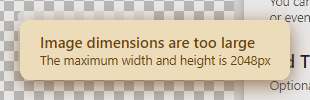
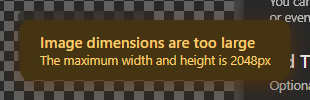
If the image isn't quite right, you'll get an error message, like so:
SVG
SVG stands for Scalable Vector Graphics. It's an image type that can be resized, big or small, without quality loss, from the same file.
This is the preferred image type, as it will look great on any display, and when printing.
Unfortunately, for security and ease of use, only basic drawing features are supported.
Gradients are also removed due to incompatibility with the PDF generation system, which isn't a big deal unless the logo must displayed in full colour.
PNG
PNGs are great as they have support for alpha channel.
Should the provided image not make use of the alpha channel then a mask will be generated using the red channel of the image.
This is perfectly acceptable for black and white images, where black will be treated as completely transparent.
The image should be at least 300 pixels wide or tall.
Please note that some websites may offer you a WebP image that's presented as a PNG. The logo editor will alert you, and reject those.
Support for WebP may be added in the future.
JPEG
These images don't make for good quality logos, due to compression artefacts and the lack of transparency.
The editor will automatically generate a mask from the chosen image, using the red channel.
I would like to ask that you avoid using JPEGs if at all possible, but I'm providing the option nevertheless.
Details
Inset
This setting is helps logos avoid being pressed right up against the sides of a performance, which can lead to reduced visual clarity.
Depending on the logo, and its aspect ratio, you may find this setting helpful.
It only adds a small amount of padding to the left and right sides, no vertical padding is added.
Introduced
This is the date when the logo was first used.
It's used to help automatically display the correct logo for a planner based on the event's date.
This keeps things historically accurate.
You don't have to be exact, you can just pick the 1st of the month.
And if the logo is quite old, then picking January is fine.
End Date
This marks the last day that the logo was used.
Again, this helps qplanner automatically pick the correct logo to display.
If the logo is still in use then please leave this blank!
Recolourable
I strongly encourage you to leave this enabled.
Recolouring a logo helps it blend into the theme of the planner, and the user's selection.
I have left this option available for the extremely small selection of logos that may need it.
It is better to spend the time editing the opacity of coloured elements.
You could, for example, convert the image to greyscale, on a black background, and have the editor use that as a mask instead.
This is a pretty quick process for PNGs, but I do recognise it could be fiddly for SVGs. (Export them to PNG if need be)
Image Artist
This isn't displayed anywhere, I just thought it would be good to credit the artist.
Applying a logo
Logos aren't automatically applied to performances as the artist may have more than one performance during the event.
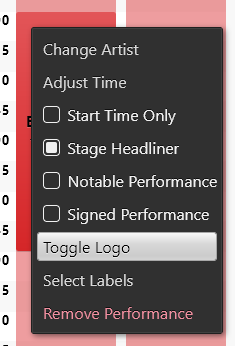
To apply the logo, simply right click on the performance and click Toggle Logo.
qplanner will check if a logo available for an artist when you open the context menu, and automatically enable the Toggle Logo option.
If the option doesn't become interactive after a second, then please check if a logo is available from the artist's section.
If you're certain that there should be a logo available, but it's not showing up, and qplanner seems to be functioning well, try reloading the page.